


Budgeting Made Simple for Adults Who Are Still Learning to Adult

Updated: 5 days ago
This article is dedicated to oxana.dc, who asked me to write it because she, like so many others in the Gen Z generation, was not taught this part of adulting before she became an adult. Hang in there, sweet girl, you'll get there in no time 🖤
Nobody handed you a manual for this. School taught you the Pythagorean theorem and spent months teaching you how to draw a line graph. Nobody taught you how to make a paycheck last until the end of the week let alone until the next paycheck.
So here is the budget I have taught my own kids since they were little. It only has three rules. It's so easy you can do it on a napkin.
Rule 1: There is a difference between what you WANT and what you NEED
I have said this to my kids for years. A need is something you cannot live or work without. A want is something that makes life nicer.
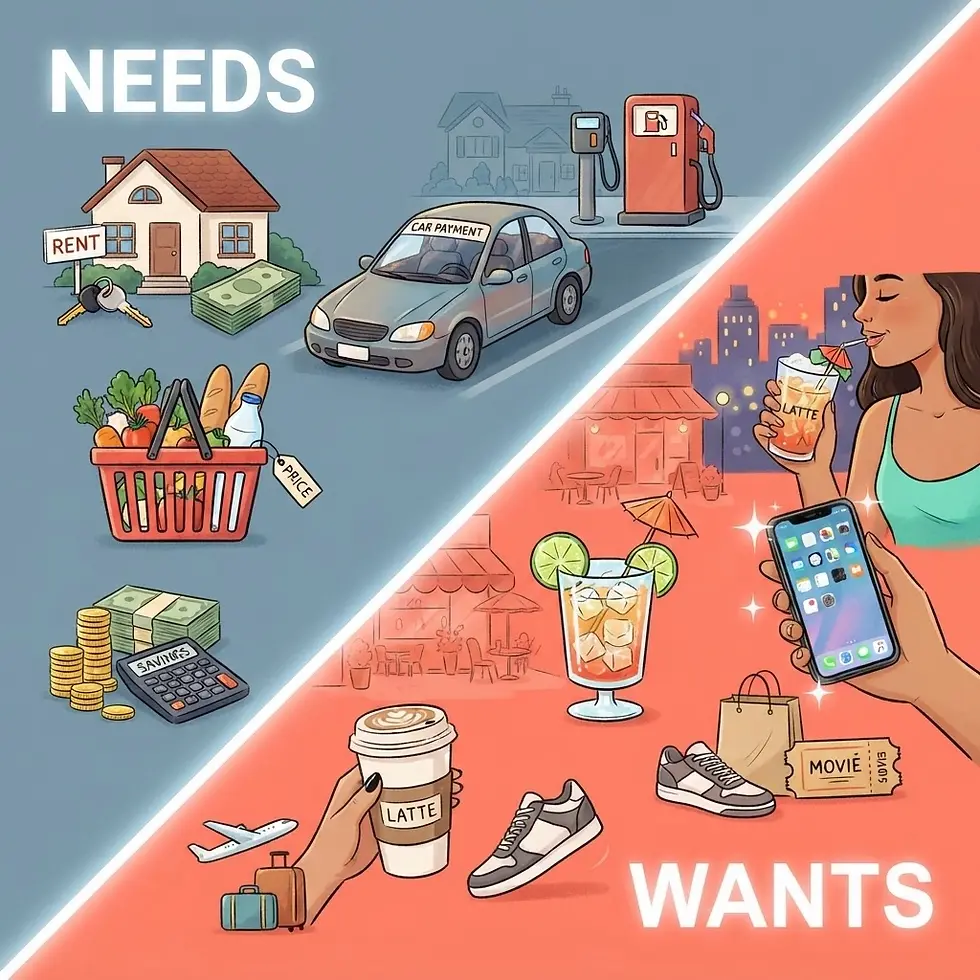
Needs usually look like this:
Rent or housing
Utilities (power, water, internet you need for work or school)
Groceries (real groceries, not the DoorDash version)
Transportation to get to work or school (and the fuel you use)
Insurance and required bills
Minimum payments on debt
Medicine and health care
Wants usually look like this:
Takeout and drinks out
Streaming and extra subscriptions
Impulse shopping
Upgrades you did not need
Here's the catch. Some things are both. You need food, but you do not need the $19 salad delivered. You need a phone, but you may not need the newest one. Be honest with yourself about which side of the budget line it lands on.
Step one: add up what your needs cost. Every month. All of them. Write the number down.
What needs really cost (real 2026 averages, rounded to easy numbers):
Rent, 1-bedroom: about $1,200/month— ApartmentList national rent report, October 2026.
Groceries, one person: about $300/mo— Bureau of Labor Statistics Consumer Expenditure Survey, updated to August 2026 grocery prices.
Car payment: about $540/month used, $765/month new — Experian, Q2 2026.
Car insurance, full coverage: about $175/month — AAA "Your Driving Costs," September 2026. That figure is for an experienced driver (6+ years, no accidents) — drivers under 26 usually pay more, and lenders require full coverage on any financed car.
Car insurance at 20–26 (full coverage, MoneyGeek 2026): about $200/month for a 20-year-old woman vs $215 for a 20-year-old man — guys pay more. The gap shrinks fast: by 26 it's about $115 for both. Seven states (CA, HI, MA, MI, MT, NC, PA) ban gender-based pricing entirely.
Those are national averages — your city will argue with them. Use them as a starting guess, then swap in your real numbers.
Rule 2: Put back half of what you have left
Take your paycheck. Subtract your needs. Whatever is left, put half of it away for savings and emergencies.
Example math only, these are made-up numbers to show how it works:
Monthly take-home pay: $2,000
Needs: $1,300
Left over: $700
Half goes to savings: $350
The rest, $350, is yours to spend on wants
That's it. You are not giving up fun. You are deciding the fun budget before the month starts instead of finding out on the 24th that it's gone.
Park your savings somewhere it grows
Rule 2 says put half of what's left into savings. But here's what nobody tells you: where you put it matters.
Did you know that there are certain bank accounts that will actually pay you money just for you to keep your own money in that account?
A regular savings account at a big bank pays you almost nothing — pennies. A high-yield savings account is the same kind of account. It just pays you real money for keeping your cash there.
The number to look at is called APY. That's just how much the bank pays you per year. Bigger number, more free money.
Look for three things: no monthly fee, no minimum balance games, and FDIC insured — that last one means your money is protected even if the bank fails.

Five banks worth looking at (rates as of November 2026 — they change, so check before you open anything):
SoFi — 3.30%, up to 4.40% for the first 6 months with direct deposit
Synchrony Bank — 3.75%, no minimum
CIT Bank — 3.75% on balances of $5,000+
Marcus by Goldman Sachs — 3.50%, no minimum, no games
Wealthfront — 3.55%
These are all online — no branch to drive to. That's exactly why they can pay you more.
Pack it and take it with you
Buy real groceries — cheap and off brand, but still good — and take your lunch or dinner to work or school with you. Every student union and every workplace has water and a microwave. Get an insulated bag and some freezer packs to keep your food cold until you are ready to warm it up and eat it.
Carving out thirty to sixty minutes a week to make your lunches and dinners to go will save you SO much money.
And no, a latte is not an emergency
Let's define the word, because it keeps getting stretched.
An emergency is: a car repair you need to get to work. A medical bill. A sudden job loss. A broken laptop you ed for school.
An emergency is NOT: a latte. Dinner and drinks with your friends. A sale. Concert tickets. Feeling sad and wanting a treat.
If your emergency fund is for "I wanted it," it is not an emergency fund. It is a want fund with a better name. Hide it from yourself if you have to, but don't touch the emergency stash until you have a legitimate emergency.

Rule 3: Learn to say NO
This is the hard one, and honestly it's the one that decides whether the first two work.
Sometimes you have to tell yourself no. And, sometimes, you have to tell the people who want you to go out no. Real friends can handle it without tossing drama, shade and guilt your way. A lot of them are broke too and will secretly thank you.
Some ways to say it without drama:
"I'm not doing dinner out this week, but I'll come for dessert at your place or I’ll host dessert at mine."
"That's not in my budget this month. Rain check?"
"I'm saving for something. Can we do a free thing?"
Saying no to a night out is not the same as saying no to your friends. It is saying yes to not panicking when the car breaks down.
Growing up poor taught me this: what to buy cheap and where not to cut costs!
Off-brand is fine for:
Pantry basics like rice, beans, flour, sugar, pasta and canned veggies
Pain relievers and allergy meds (same active ingredient, check the label)
Basic cleaners and dish soap
Snacks, cereal and frozen veggies
Do NOT go cheap on:
Laundry detergent. Never. The cheap stuff makes you rewash, and that costs you more.
Paper towels - you use 2-3 times as many of the cheap ones, which means you're buying them 2-3 times more often, which means you're already spending as much if not more than you would on the quality name brand item, anyway.
Squeeze the tube
Toothpaste, face cream, any tube. When it looks empty, cut it open about three quarters of the way down. Scrape everything out with a toothpick or a small spatula. Put it in a ziplock baggie or a little tupperware container. That "empty" tube still has days or weeks left in it, which means you don't have to spend the money to replace it right now.
Unplug the little guys
Full disclosure, I don't understand the science behind any of this next money-saving tip, but when I asked my husband (who is both brilliant and a NETA technician) to explain it to me like I'm "just a girl," this is what he said:
"To put it simply, your house already consistently draws power in order to provide power to your outlets, lights, AC, etc. When you plug a device in and don't use it, you are drawing more power to that device to keep it ready to be used. It's not necessarily a lot of usage, but still it's excessive and wasteful. By keeping the device unplugged until you're ready to use it, you draw less power to your home and help keep the bill in check."
~ Interview with Dustin Vincent, certified NETA technician
The short version: even when something is turned off, if it is still plugged in, it can keep pulling a small amount of power, and you pay for it. It's not a lot per item, but it adds up across a house.
Unplug the things you are not using: the TV, coffee pot, toaster, air fryer, game consoles, phone chargers. Unplug those bad boys.
Dustin also sent this more thorough breakdown:
Benefits of Unplugging Unused Home Devices
Unplugging devices that are not in use can lead to significant advantages for both your finances and safety.
Save Money on Electricity
Many household appliances and electronics continue to draw power even when turned off, often referred to as “phantom load” or “vampire power.” This idle energy consumption can account for approximately 10% of your monthly electricity bill.
By unplugging these devices, you can potentially save between $100 and $200 annually on your energy costs. (The U.S. Department of Energy puts standby power at 5–10% of home electricity use, costing up to about $183 a year; the Natural Resources Defense Council estimates about $165 a year per household.)
Reduce Fire Risks
Leaving appliances plugged in increases the risk of electrical fires. Devices with heating elements, such as toasters and coffee makers, pose a higher danger if left unattended. Unplugging these appliances when not in use minimizes the chance of accidental activation or malfunction, thereby enhancing home safety.
Common Energy Vampires
Here's a list of common devices that should be unplugged when not in use:
Small kitchen appliances: toasters, coffee makers, blenders
Entertainment devices: TVs, gaming consoles
Chargers: phone and tablet chargers
Make friends with the older lady down the street
If you live near an older lady, MAKE FRIENDS!!! Carry her groceries in. Be nice to her cat. She will feed you, and it will save you money. (She also gets company and help, so everybody wins.)
Cheap meals that don't taste like cardboard
Depending on where in the world you're budgeting from, I put together cheap meals that will fill you up and don't taste like cardboard to help you stretch your paycheck. Three meals with meat and three without for the US, Japan, France, Germany, the UK, China and Mexico.
Here they are: Broke but Fed — 42 cheap meals from 7 countries
YOUR 10 MINUTE STARTER
Grab the worksheet first: https://docs.google.com/spreadsheets/d/1Q5q52EM2biC6NScS-eWELaR3RUVOk2NMcv8GY56R_-o/copy Tap any box and type right on your phone, no printing, no markup — and it does the math for you: totals, what's left, and both halves fill themselves in.
TO ADD IT AS A SHORTCUT ON YOUR PHONE HOMESCREEN
Tap "Make a copy" after going to the link above. Once you are on the actual sheet, complete the following steps. iPhone: open it in Safari, tap Share, then Add to Home Screen. Android: open it in Chrome, tap the three dots, then Add to Home Screen. Keep it in the same folder as your rent and car insurance apps. That's the bubble where your money lives.

Follow These Steps:
Open your banking app and look at the last month.
Circle every need. Add it up.
Subtract it from your take-home pay.
Cut what is left in half.
Move that half into savings the day you get paid, before you can spend it.


Comments